
Terra Cotta vs. Concrete Roofing Tiles
Executive Takeaway
Terra cotta is a fired‑clay, vitrified roofing tile with naturally low porosity and century‑long durability. Concrete is a cement‑based composite that imitates clay’s appearance but differs significantly in weight, absorption, weathering, and long‑term performance.
Material Composition
Terra Cotta — refined clay + minerals, fired at high temperatures until vitrified
Concrete Tile — cement, sand, aggregates, and pigments molded into tile form
Terra cotta is a ceramic. Concrete is a composite.
Porosity & Water Absorption
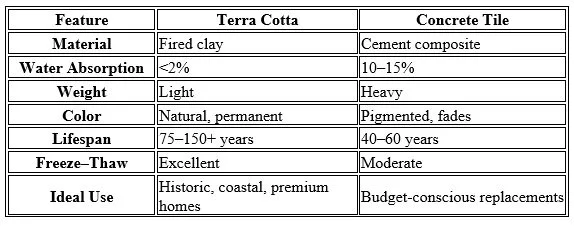
Terra Cotta: naturally low absorption (<2%)
Concrete: higher absorption (10–15%), often requiring sealants
Higher porosity means concrete tiles gain weight when wet—critical for historic structures in Newport, Bristol, and the Cape.
Weight & Structural Load
Terra Cotta: lighter, stable weight
Concrete: heavier, variable weight when saturated
Many historic homes cannot support concrete tile loads without structural reinforcement.
Color & Finish
Terra Cotta: color is baked into the tile; patinas gracefully
Concrete: surface pigments fade; coatings require periodic reapplication
Concrete ages like masonry, not ceramic.
Freeze–Thaw Performance
Terra Cotta: exceptional freeze–thaw durability
Concrete: prone to micro‑cracking over decades
This is a major differentiator in Southern New England’s climate.
Lifespan
Terra Cotta: 75–150+ years
Concrete: 40–60 years
Terra cotta is generational. Concrete is mid‑term.
Why Premium Homes Choose Terra Cotta
For upscale coastal properties—especially historic or architecturally significant homes—terra cotta offers:
Authenticity in restoration projects
Superior coastal durability
Long-term value
Architectural prestige
Concrete may imitate the look, but it cannot replicate the heritage, durability, or material integrity of true clay.
Installation & Maintenance
Terra cotta requires specialized handling, correct batten systems, and precise flashing details—ideal for a specialty firm like Slate & Copper Services.
Concrete requires structural load evaluation, periodic sealing, and more frequent replacement cycles.
Closing Perspective
For homeowners in coastal Rhode Island, Connecticut, and Southeast Massachusetts—where salt air, freeze–thaw cycles, and historic architecture converge—terra cotta remains the superior choice. Concrete tiles have their place, but they simply do not match the longevity, authenticity, or performance of true clay.
